Foundation Repair · Problem Signs

Rotten wood under your home is a moisture problem first, and a structural one if it is left alone

When the beams, joists, and sill plates in a crawl space stay damp, the wood softens, darkens, and loses the strength it needs to carry your floors. Here is what drives wood rot across the Carolinas and what a no-pressure inspection looks at.

North Carolina · South Carolina BBB A+ Rated

Let's take the first step toward a healthy home.

A local specialist will inspect your foundation, walk you through the findings, and send a clear estimate. no cost, no pressure.

Book instantly with Driive
BBB Accredited
Fully Insured
"By Your Side" Guarantee
What this symptom means

Rotten Wood: diagnosed and explained.

Rotten wood is structural framing that has been weakened by sustained moisture and decay fungi. In a Carolinas home, the wood at risk is almost always in the crawl space: the girder beams that carry interior floors, the floor joists resting on them, the sill plate that ties the framing to the foundation, and the band or rim joist around the perimeter. Healthy framing is firm and pale. Decaying wood turns darker or grayed, feels soft or spongy, may crack into cube-like blocks as it dries, and can be pressed into or picked apart with a screwdriver. In advanced cases it crumbles or shows white or brown fungal growth and a musty smell. Because this wood sits below the finished floor, the rot usually progresses out of sight, and homeowners notice the consequences upstairs first. A floor that feels soft or springy in one spot, a section of floor that has begun to sag, a sticking door, or a baseboard pulling away from the floor can all trace back to framing that has lost strength underneath. Wood rot needs moisture to continue, so the framing and the source of the dampness have to be evaluated together. A no-pressure inspection enters the crawl space, probes the wood to gauge how far the decay has gone, measures floor elevations to see what has already moved, and identifies where the moisture is coming from before any repair is discussed.

Catch It Early

Signs that often show up alongside rotten wood framing

01

Soft, springy, or bouncy floors above the crawl space

A localized bounce or give as you step across one area, rather than a general slope, usually means the joists or beam directly below that spot have lost strength to decay and are flexing under load.

02

A musty odor that comes up through the floors

A persistent earthy or musty smell inside the home often originates in a damp crawl space, where the same moisture feeding the smell is also the moisture decaying the wood framing below.

03

Floors that have begun to sag or dip

When a rotted girder beam or weakened joists can no longer carry their load, the floor above settles into a visible droop, most often toward the center of a room rather than at an exterior wall.

04

Visibly dark, damp, or discolored wood in the crawl space

If you can access the crawl space, framing that looks grayed or stained, feels damp or spongy, shows cracking into blocks, or carries white or brown fungal growth confirms that decay is active and where it is concentrated.

05

Wood that crumbles or gives way when probed

Sound framing resists a screwdriver tip. Wood that can be pushed into, flaked apart, or pulled out in pieces has lost structural integrity and is no longer carrying its share of the load.

06

Sticking doors and small cracks at door and window corners

As the floor system loses support and settles, framing racks slightly out of square. Doors that begin to stick and hairline diagonal cracks at the corners of openings can appear around the same time crawl space wood is failing underneath.

Most Common Causes

What causes rotten wood in Carolinas homes.

Ground moisture vapor rising into the crawl space
Most Carolinas crawl spaces sit over bare or minimally covered soil. Moisture in that soil evaporates upward as vapor and condenses on the cooler wood framing above, keeping beams and joists damp through much of the year. Across the Piedmont around Charlotte, Greensboro, and Winston-Salem, the SC Upstate around Greenville, and the Midlands around Columbia, this steady ground-vapor load is the single most common reason crawl space wood stays wet long enough to rot. The wood is not getting rained on. It is being soaked from below, day after day, by vapor coming off the ground.
Humid Carolinas summers and outside air venting into the crawl space
Long, humid summers across the Piedmont, the Sandhills, and the Carolinas coast push moisture-laden outdoor air into vented crawl spaces. When warm, humid air meets cooler crawl space framing, it condenses on the wood and on ductwork, wetting the very surfaces that need to stay dry. The traditional open foundation vent was meant to dry a crawl space out, but in this climate it often does the opposite for much of the year, feeding the moisture that decay fungi need to take hold in joists and beams.
Standing water and drainage intrusion in the crawl space
Water that collects on the crawl space floor keeps the air saturated and wets the framing directly where joists and beams sit low or where the sill plate meets the foundation. In the Piedmont, the clay-rich soil's seasonal moisture swing can push groundwater up into the crawl space during wet stretches. Around Asheville and the mountains, hillside lots and heavy rainfall send runoff and subsurface water toward and under the home. Interior crawl space and basement drainage falls within our crawl space and waterproofing work, and resolving that intruding water is a routine part of stopping recurring rot.
High water table and saturated sandy soils on the coast
In coastal markets like Wilmington, Leland, and Brunswick County, a high water table and sandy, saturated soils keep the ground beneath the home wet and the crawl space humid for long periods. Salt air adds a corrosive element to the coastal environment. The persistent dampness of wet, sandy ground accelerates decay in sill plates, band joists, and floor framing, so rotten wood on the coast is typically tied to water saturation and a chronically humid crawl space rather than to the clay shrink-swell that drives it inland.
Plumbing leaks, condensation, and poor crawl space airflow
A slow supply-line drip, a sweating water line, or condensation on cold ductwork can wet a localized area of framing and start rot directly above it. Combined with a crawl space that does not dry out, even a small, steady moisture source is enough to soften a joist or a section of beam over time. This is why rot is sometimes concentrated under a bathroom, a kitchen, or a laundry rather than spread across the whole crawl space.
Permanent Solutions

How foundation repair specialists actually fix rotten wood.

Solving rotten wood means addressing the underlying soil, pressure, or settlement cause. Not just patching the visible damage. Below are the engineered solutions we install most often for this symptom in Carolinas homes.

Foundation Repair solutions
Regional Context

Why foundation movement across the Carolinas needs a regional diagnosis

Foundation movement behaves differently depending on where your home sits. In the Piedmont around Charlotte, Greensboro, Winston-Salem, and the Triangle, clay-rich soils absorb water in wet seasons and pull away from foundations as they dry, cycling pressure on your footings year after year. On the coast around Wilmington, Brunswick County, and Leland, a high water table and sandy, saturated soils create lateral pressure and settlement that inland clay never produces. In the mountains around Asheville, hillside lots and runoff load one side of a foundation more than the other. That is why our team starts with the soil and slope under your home, not just the crack on the wall.

Piedmont
Clay-rich soil belt
Charlotte to the Triad
Wet / dry
Seasonal moisture swing
Soil expands, then contracts
Coastal
High water table & salt air
Wilmington & Brunswick County
NC + SC
Local, no-pressure crews
Offices across the Carolinas

Piedmont clay and the crack patterns it produces

Much of the Piedmont, from Charlotte through the Triad, sits on clay-rich soil that holds water. Clay absorbs moisture in wet seasons and swells, then contracts in dry periods. That cycle pulls pressure on and off a foundation, pulling away from footings, creating voids beneath slabs, and producing the vertical and diagonal settlement cracks we see most frequently across the region.

Homes built on uncompacted clay backfill show the highest incidence of progressive settlement cracking in our inspection work. The same clay that looks stable through a normal year can move enough during a long wet spring or a hard summer drought to open a crack that keeps widening.

Coastal and Sandhills soils behave differently

In Wilmington, Brunswick County, and Leland, high water tables, saturated and sandy soils, and salt air drive a different set of failure modes than inland clay. Lateral water pressure, erosion, and corrosion are the drivers here, which is why coastal foundation and seawall work needs an approach that inland techniques don't account for.

Across the Sandhills near Fayetteville and Pinehurst, sandy soils drain differently again, and in the mountains around Asheville, hillside foundations, slopes, and heavy rainfall change the picture once more. We diagnose to the soil and climate of the specific home, not to the Carolinas generically.

"When someone calls about rotten wood, the wood is really telling us there is a moisture problem in the crawl space. We go under the house, find the framing that has actually lost strength, and just as importantly find out where the water is coming from. If the wood is stained but still sound, we will tell you that. If it needs reinforcing, we fix the framing and the moisture together, because replacing a beam and leaving the crawl space wet just starts the clock over. There is no pressure and no upsell here."
CP
Cory Parks
Owner, HydroHelp911
Why Choose HydroHelp911

Care and expertise from a team that does this every day.

HydroHelp911 is locally owned and operated, with crews dedicated exclusively to foundation, basement, and concrete work across the Carolinas.

Specialized expertise.

Foundation repair, waterproofing, and concrete leveling are our entire focus. not a sideline.

Locally owned and operated.

Deep experience with Carolinas soils, basements, and weather conditions.

BBB A+ rated.

Accredited with an A+ rating and thousands of homeowner reviews across the Carolinas.

Warrantied solutions.

Lifetime warranties available on many services, backed by the original installer.

HYDROHELP911

Why hire HydroHelp911.

MEET THE TEAM · 2 MIN
Frequently Asked Questions

Answers to common questions about Rotten Wood.

Don't see your question here? Our team is happy to help. Reach out anytime.

Rotten wood in a Carolinas crawl space is almost always a moisture problem. The leading source is ground moisture vapor rising off bare soil and condensing on the framing above. Long, humid summers push damp outdoor air into vented crawl spaces, where it condenses on cooler wood, and standing water or a plumbing leak can wet framing directly. In the Piedmont, the clay-rich soil's seasonal moisture swing can raise groundwater into the crawl space. On the coast around Wilmington and Leland, a high water table and saturated sandy soils keep the crawl space humid. Decay fungi need that sustained dampness to grow, which is why resolving the moisture is central to stopping the rot.

Pricing ranges above are general estimates only and are not project quotes. A precise figure is provided on each written estimate after on-site inspection.
Related Problem Signs

Other foundation repair warning signs to watch for.

If you see one, it's worth checking for the others. Most foundation problems show up as more than one symptom.

01

Bouncing Floors

Bouncing floors have a feel you notice before you can see anything. A floor flexes underfoot as you cross a hallway, dishes rattle in a cabinet when someone walks past, or a specific spot in a room gives slightly with each step. The bounce is often worse over the middle of a room or along a particular run of floor rather than everywhere at once. Bouncing floors are a symptom, not the root problem. The floor covering itself is rarely the issue. What has usually moved is the structure carrying the floor: a girder beam in the crawl space that has begun to sag, floor joists that have weakened, a support pier that has shifted or settled, or a foundation that has dropped under one part of the home. Because that support sits below the finished floor, the reliable way to know what is happening is to go underneath, inspect the framing and supports, and measure the floor elevations across the structure. That is what a no-pressure inspection is for.

Learn More
02

Bowing Walls

A bowing wall is a foundation or basement wall that has bent, curved, or leaned out of its original vertical plane under sideways pressure from the soil behind it. Foundation walls are built to hold back the earth and carry the weight of the house above, but they are far stronger against downward load than against sideways, or lateral, force. When the soil outside the wall pushes inward harder than the wall can resist, the wall begins to give. On a poured concrete wall this often shows as a horizontal crack across the middle and an inward bulge. On a concrete block or brick wall it usually shows as a horizontal or stair step crack along the mortar joints, with the wall leaning in at the top, sliding in at the base, or bulging through the center. Bowing is different from a sinking or settling foundation. Settlement is the footing dropping straight down, while bowing is the wall being pushed sideways, and the two are stabilized in different ways. The amount a wall has moved matters a great deal. A wall that is out of plumb by a small amount and has been stable for years is a different situation than one that is visibly bulging, has a widening horizontal crack, or has shifted more than an inch or two. Because the force comes from the soil and water on the outside of the wall, you cannot judge from inside the basement alone how far the wall has moved or whether it is still moving. A no-pressure inspection measures the wall's deflection, examines the soil and drainage conditions around it, and identifies the cause before any repair is discussed.

Learn More
03

Ceiling Gaps

A ceiling gap is a visible separation that opens along the joint where the top of an interior wall meets the ceiling above it. You might see a thin dark line appear over a wall that used to sit tight against the ceiling, crown molding or trim pulling down and away from the drywall, or a corner of a room where the ceiling and two walls no longer meet cleanly. These gaps tend to open gradually and run in a straight line along the top of the wall, which is what sets them apart from the random hairlines that show up elsewhere in drywall. A ceiling gap is a symptom, not the root cause. The ceiling and the wall are rarely the problem themselves. What has usually moved is the framing that ties them together, and the foundation or supports beneath it. When part of a foundation settles, or an interior support sags, the walls and the floor system attached to it drop while the ceiling framing above stays put, and the joint between them is pulled open. There is an important fork here. One specific cause of a wall-to-ceiling gap is benign and seasonal: truss uplift, where the roof trusses in an attic arch upward in cold, dry winter months and settle back in humid summer months, lifting the ceiling slightly and opening a gap at interior walls that closes again when the weather turns. A gap that opens every winter and closes every summer, with no other signs, usually traces to this. Other ceiling gaps point to foundation or framing movement that does not reverse on its own and tends to widen over time. Because seasonal truss uplift and structural settlement can look similar at the joint, the reliable way to tell them apart is to look at the gap alongside the foundation, the crawl space, and the alignment of the walls and floors across the home. That is what a no-pressure inspection is for.

Learn More
04

Cracked Block Foundation

A cracked block foundation is a fracture that runs through the mortar joints between concrete blocks, through the blocks themselves, or through both, in a concrete masonry unit (CMU) foundation wall. The pattern of the crack is the most important clue to what is happening below. A crack that steps diagonally up the mortar joints from one block to the next, in a staircase shape, usually points to differential settlement, meaning one part of the foundation has dropped relative to the rest. A long horizontal crack running along a single mortar course, often near the middle or lower third of the wall, usually points to lateral soil pressure pushing the wall inward, and it frequently appears together with the wall bowing or leaning. Vertical cracks tend to show up where two sections of wall pull apart or at the edge of an opening. Because a hollow block wall is strong in compression but weak in bending, it cannot flex when the ground moves, so it splits along the joints instead. A cracked block foundation is a symptom, not the underlying problem. The width of the crack and whether the two sides have shifted out of plane say a lot about how much movement has occurred. A hairline crack that has been stable for years is a different situation than a crack wider than a quarter inch where the wall has shifted out of line or started to bow. Because the cause sits in the soil and footing around the wall, the only reliable way to know what is happening is to inspect the foundation and measure how the structure has moved, which is what a no-pressure inspection is for.

Learn More
05

Cracked Bricks

Cracked bricks are fractures that run through the brick units themselves, through the mortar joints between them, or through both, on a home's exterior brick veneer or a brick foundation wall. The cracks can be diagonal, vertical, or horizontal, and they tend to concentrate near corners and around windows and doors, because that is where stress collects when a wall is pulled out of square. Brick is strong in compression but weak in tension and bending, so when the foundation below the wall settles unevenly, the wall cannot flex and the brick splits instead. A crack that follows the mortar in a diagonal staircase usually points to differential settlement below, while a long horizontal crack low on a brick foundation wall often points to soil pushing inward against the wall. Cracked bricks are a symptom, not the underlying problem, and the width of the crack and whether the two sides have shifted out of plane say a lot about how much movement has happened. A hairline crack that has been stable for years is a different situation than a crack wider than a quarter inch where the brick faces no longer line up. Because the cause sits in the soil and footing below the wall, the only reliable way to know what is happening is to inspect the foundation and measure how the structure has moved, which is what a no-pressure inspection is for.

Learn More
06

Cracks in Door Frames, Ceilings, and Corners

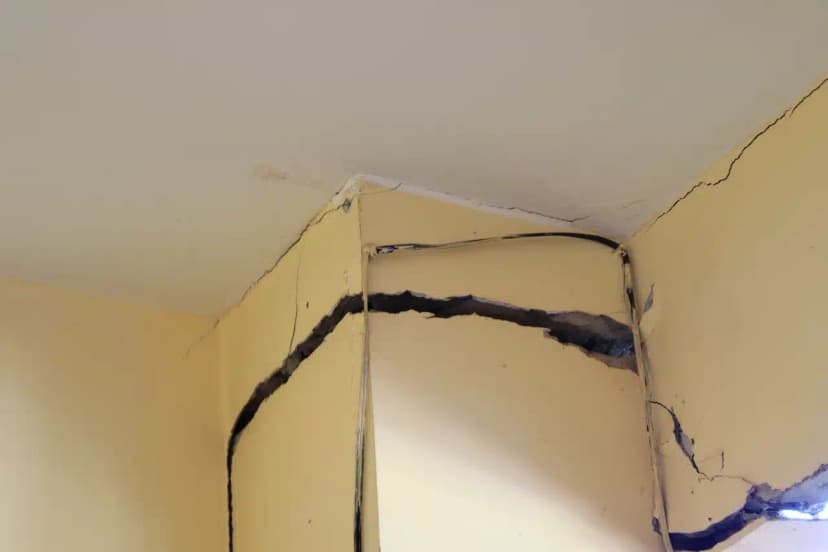
Cracks in door frames, ceilings, and corners are the splits and seams that open up at the most predictable weak points inside a home. They cluster at the upper corners of door and window openings, along the line where a wall meets the ceiling, in the corners where two walls come together, and across ceilings over an interior beam. These locations crack first for a simple reason. When a structure shifts, stress concentrates wherever the framing is interrupted or changes direction, and the rigid finish surface fastened to that framing has to split somewhere to absorb the movement. The crack is a symptom, not the underlying problem. The plaster or drywall almost never fails on its own. What usually moves is the framing and the foundation behind it. When a foundation settles or heaves unevenly, the walls and ceilings above it rack slightly out of square, and the corner of a door frame is exactly where that racking shows up as a diagonal crack. There is an important fork here. Some of these cracks are cosmetic and expected. New homes settle, framing lumber dries and shrinks for the first year or two, and seasonal humidity swells and releases the studs, so a thin, stable hairline at a corner or along a ceiling seam is often harmless. Other cracks point to foundation or framing movement that does not reverse on its own. Diagonal cracks running out of door frame corners, cracks wider than about a sixteenth of an inch, cracks where one side has pushed out of plane from the other, and cracks that keep coming back after they are patched are the patterns that warrant a closer look. Because a cosmetic crack and a structural one can look similar from inside a room, the reliable way to tell them apart is to inspect the cracks alongside the foundation, the crawl space, and the alignment of the doors and floors. That is what a no-pressure inspection is for.

Learn More
Service Areas

Serving North Carolina & South Carolina.

Local crews based in offices across the Carolinas, dispatched daily. If your town isn't listed, call us. we likely serve your area.

Top cities we serve
Check Your Service Area
Our Process

Take the first step toward a healthy home.

A straightforward path from initial inspection to completed repairs.

Step 01

Schedule your inspection.

A local specialist visits your home, evaluates the foundation, and answers your questions on site. No cost, no obligation.

Step 02

Receive an estimate based on your needs.

We provide a clear, written estimate with a scope of work tailored to your home's specific issues. Typically within one business day.

Step 03

Get your repairs.

Our certified crews complete the work on schedule and back it with product warranties of up to 25 years.

Customer Reviews

Over 1,750 homeowners have shared their experience.

A 4.9-star average across Google, with verified reviews from homeowners throughout North and South Carolina.

Free Estimate

Two ways to start: book instantly, or request an estimate.

Schedule your inspection in seconds with our Driive booking tool, or share a few details and a local specialist will follow up within one business day.

What to expect
  • A local foundation specialist on site
  • A complete walk-through of the findings
  • A written estimate within one business day
  • No cost, no obligation, no high-pressure sales
Prefer to call
704-610-4399
North Carolina · South CarolinaBBB A+ Rated
HydroHelp911

Let's take the first step toward a healthy home.

A local specialist will inspect your foundation, walk you through the findings, and send a clear estimate. no cost, no pressure.

Book instantly with Driive
BBB Accredited
Fully Insured
"By Your Side" Guarantee
Our Locations

Local offices across the Carolinas.

See all service areas
Dallas, NC
HydroHelp911
111 Iron Station Rd
Dallas, NC 28034
704-610-4399
Huntersville, NC
HydroHelp911
14936 Brown Mill Rd Ste 9
Huntersville, NC 28078
704-610-4399
Matthews, NC
HydroHelp911
11145 Monroe Rd Ste 105
Matthews, NC 28105
704-610-4399
Asheville, NC
HydroHelp911
34 Wall St #805D
Asheville, NC 28801
704-610-4399
Wilmington, NC
HydroHelp911
201 N Front St Ste 214
Wilmington, NC 28401
704-610-4399
Greensboro, NC
HydroHelp911
1515 W Cornwallis Dr Suite 201-B
Greensboro, NC 27408
704-610-4399
Greenville, SC
HydroHelp911
7 Brendan Way #13
Greenville, SC 29615
704-610-4399
Columbia, SC
HydroHelp911
1122 Lady St Suite 208
Columbia, SC 29201
704-610-4399