Retaining wall anchoring systems: holding a leaning or bowing wall against the slope behind it
When the graded soil behind a retaining wall pushes harder than the wall can hold, an anchoring system ties the wall back into stable ground across North and South Carolina.

Let's take the first step toward a healthy home.
A local specialist will inspect your foundation, walk you through the findings, and send a clear estimate. No cost, no pressure.
What retaining wall anchoring systems is and when it's the right call.
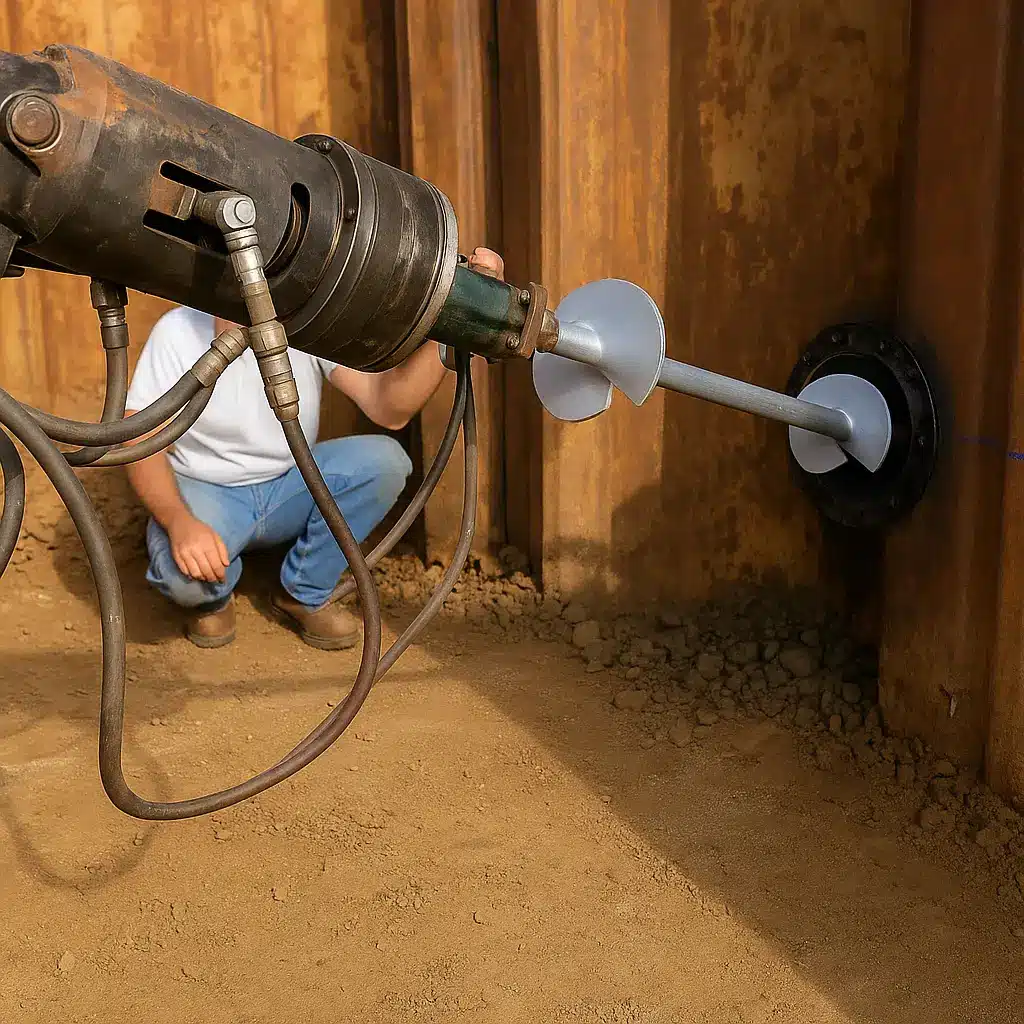
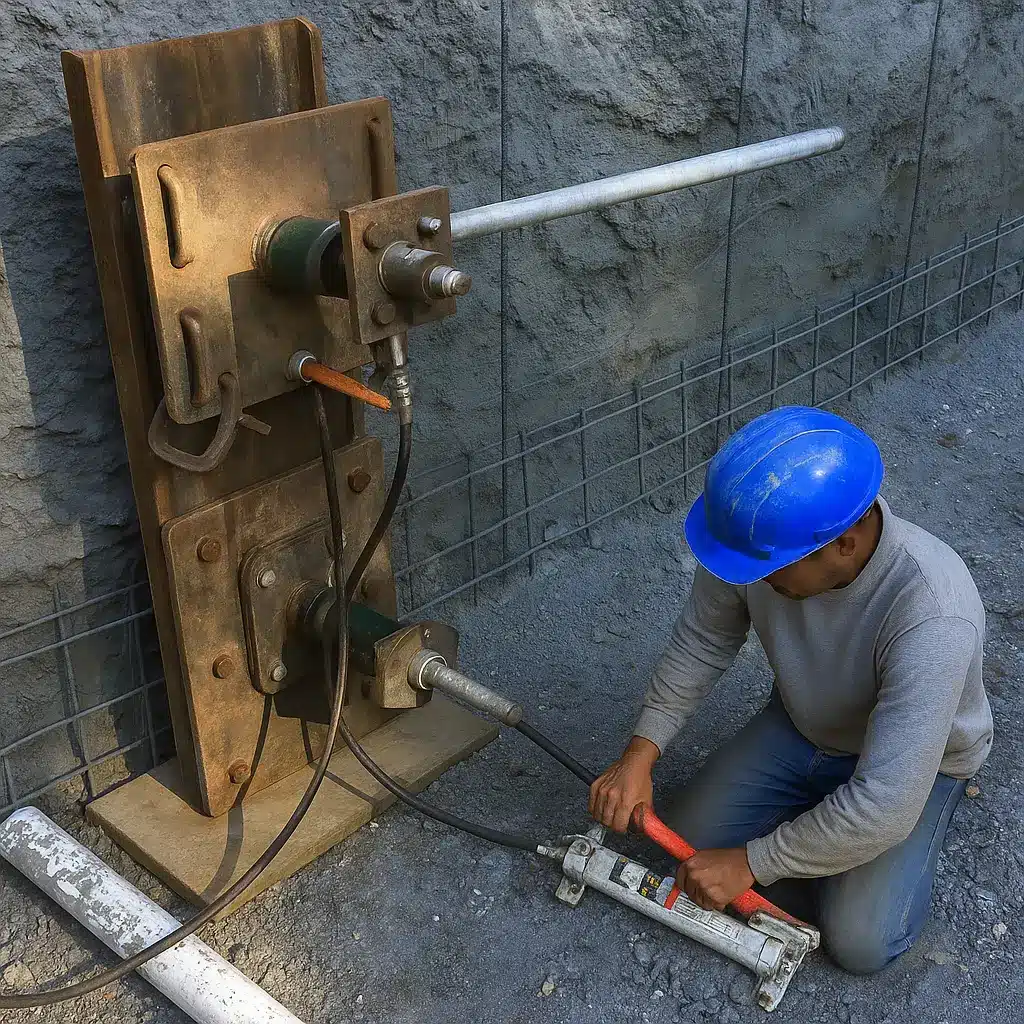
A retaining wall anchoring system counters lateral pressure by transferring the wall's load into soil that is strong enough to resist it. The principle is straightforward. The wall is leaning because the soil immediately behind it is pushing harder than the wall can hold, so the anchor reaches past that pressurized soil and ties the wall to stable ground beyond it. Most anchoring systems use one of two approaches. A helical anchor uses a steel shaft with helical plates, much like a screw, that is rotated into the soil at an angle extending back and away from the wall until the plates reach denser, more stable ground where the anchor develops holding capacity. A mechanical wall anchor uses an anchor plate set in stable soil out beyond the slope, connected by a steel rod back to a plate on the face of the wall. In both cases the connection is tightened so the anchor engages and holds the wall against the soil load. Because the holding power comes from soil conditions, the depth, spacing, and number of anchors are not fixed numbers. They depend on the height and length of the wall, how far it has moved, the type of wall, and what the soil behind and beyond the wall is actually doing, which is why diagnosis comes before any installation. An anchoring system stabilizes the wall and stops the outward movement, and in many cases the wall can be tightened gradually over time to recover some of its original alignment. What anchors do not do on their own is remove the water that is creating the pressure. On Asheville slopes or in saturated Piedmont clay, we often discuss managing the moisture and drainage behind the wall as well, because reducing the load is part of a result that lasts.
How we install retaining wall anchoring systems.
Free, no-pressure inspection and diagnosis
We start by confirming that lateral pressure is the actual problem and measuring how far the retaining wall has moved. We look at the lean or bow, the crack pattern, how the wall is built, and the soil and drainage conditions behind it. In Piedmont clay or on an Asheville hillside, the source of the pressure shapes the recommendation, and we will tell you honestly if an anchoring system is not the right fit for your wall.
Confirm anchors are the right reinforcement
Anchoring suits walls under sustained lateral pressure that are leaning or tilting outward, but a short wall with minor movement may be better served by improving the drainage behind it. We confirm whether an anchoring system, another approach, or a combination fits your wall, then explain the plan, the anchor type, and the layout before any work begins.
Install the anchors into stable soil
Each anchor is set into soil that reaches back past the pressurized zone into denser, stable ground, either by rotating a helical anchor in at an angle or by placing an anchor plate out beyond the slope. We seat the anchor until it develops the holding capacity the wall requires, which is determined by the wall height, how far it has moved, and the soil conditions.
Connect the wall plates and engage the system
A steel plate is mounted to the face of the wall and connected to each anchor. Tightening the connection engages the anchor so it holds the wall against the soil load and stops the outward movement. Where it is appropriate, the system can be tightened gradually over time to help draw the wall back toward its original alignment.
Review the result and the drainage picture
We review the stabilized wall with you and explain what comes next. Because lateral pressure is often driven by water in the soil, we go over any drainage or moisture management behind the wall that would reduce the load, so the reinforcement holds up over the seasonal wet and dry swings common across the Carolinas. You get a clear picture of the cause, the fix, and how to protect it.
"A leaning retaining wall is slowly losing to the slope and water behind it. An anchoring system lets us reach past that pressure into solid ground and tip the balance back in the wall's favor. If better drainage or a simpler reinforcement will do the job, we will tell you that instead. No pressure, no upsell."
Care and expertise from a team that does this every day.
HydroHelp911 is locally owned and operated, with crews dedicated exclusively to foundation, basement, and concrete work across the Carolinas.
Foundation repair, waterproofing, and concrete leveling are our entire focus. not a sideline.
Deep experience with Carolinas soils, basements, and weather conditions.
Accredited with an A+ rating and thousands of homeowner reviews across the Carolinas.
Lifetime warranties available on many services, backed by the original installer.

Answers to common questions about Retaining Wall Anchoring Systems.
Don't see your question here? Our team is happy to help. Reach out anytime.
Other foundation repair solutions we install.
Every solution is engineered for a specific soil profile and failure mode. Browse the full toolkit.
Carbon Fiber Reinforcement
When soil and water pressure starts pushing a foundation wall inward, carbon fiber straps bond to the wall and resist that load, a low-profile fix for early to moderate bowing across North and South Carolina.
Learn moreConcrete Piers
Concrete pier systems carry a settled foundation's weight down to firmer, load-bearing soil across North and South Carolina, supporting the structure on ground that holds.
Learn moreDeep Foundation Systems
When the soil near the surface keeps moving, we install piers that carry your home's weight down to ground that holds. Always after a free, no-pressure inspection.
Learn moreEpoxy or Polyurethane Crack Injection
A targeted way to seal poured-concrete foundation cracks and stop water seepage across North and South Carolina, paired with an honest look at what caused the crack in the first place.
Learn moreFoundation Underpinning
When the soil near the surface can no longer carry your foundation, underpinning reaches deeper ground to stabilize the structure. Serving homeowners across North and South Carolina.
Learn moreGrout Injection (Chemical Grouting)
A targeted way to fill voids and firm up weak or shifting soil under foundations and slabs across North and South Carolina, so settlement has less room to continue.
Learn moreServing North Carolina & South Carolina.
Local crews based in offices across the Carolinas, dispatched daily. If your town isn't listed, call us. We likely serve your area.
- Charlotte, NC
- Huntersville, NC
- Matthews, NC
- Greensboro, NC
- Winston-Salem, NC
- Asheville, NC
- Wilmington, NC
- Fayetteville, NC
- Greenville, SC
- Columbia, SC
Take the first step toward a healthy home.
A straightforward path from initial inspection to completed repairs.
Schedule your inspection.
A local specialist visits your home, evaluates the foundation, and answers your questions on site. No cost, no obligation.
Receive an estimate based on your needs.
We provide a clear, written estimate with a scope of work tailored to your home's specific issues. Typically within one business day.
Get your repairs.
Our certified crews complete the work on schedule and back it with product warranties of up to 25 years.
Rated 5 stars by Carolina homeowners.
A verified 5-star average on Google, with reviews from homeowners throughout North and South Carolina.
Request your free, no-pressure inspection.
Share a few details and a local specialist will follow up within one business day to schedule your free inspection.
- A local foundation specialist on site
- A complete walk-through of the findings
- A written estimate within one business day
- No cost, no obligation, no high-pressure sales