
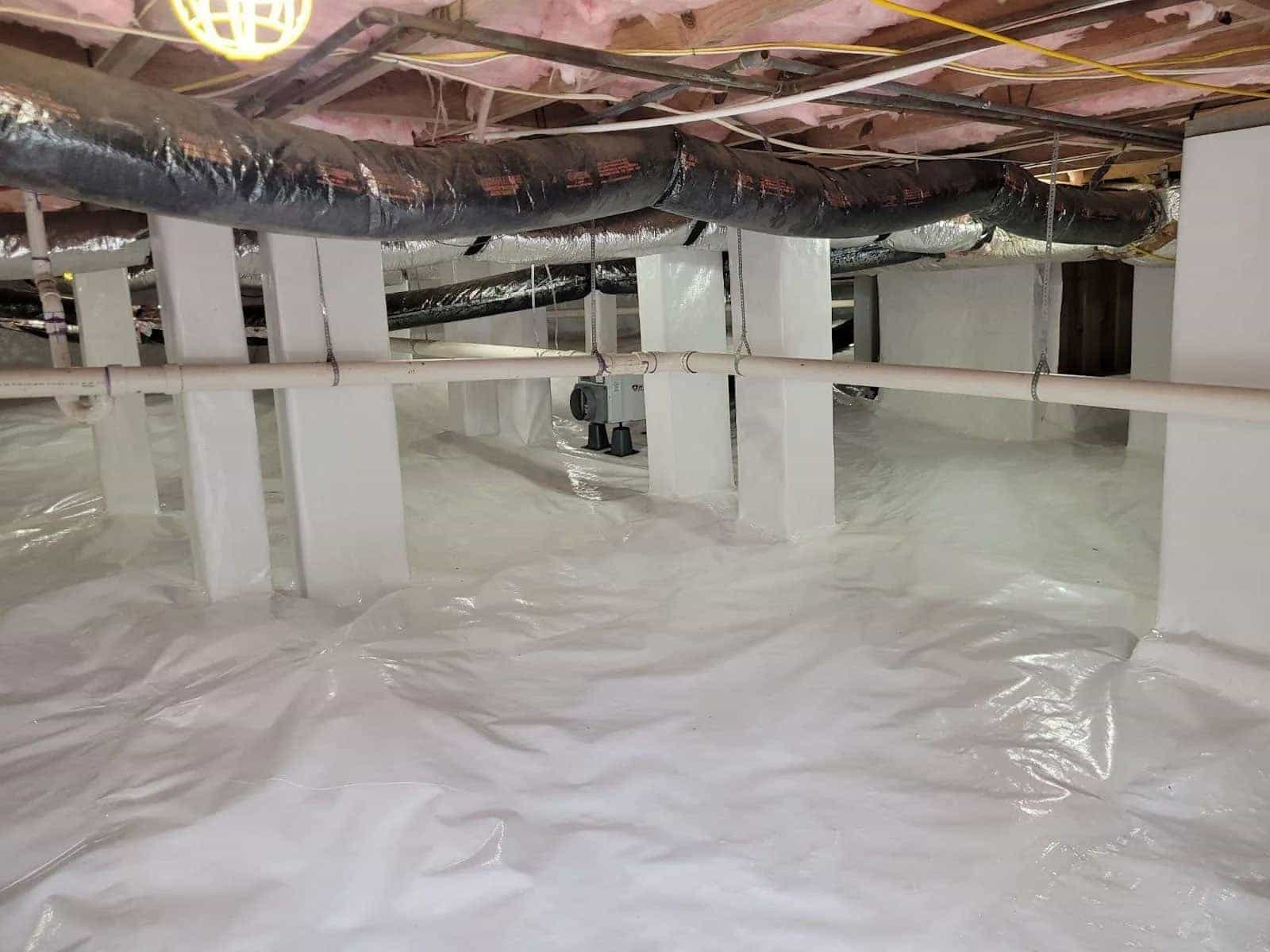
Crawl Space Encapsulation in Columbia, SC
HydroHelp911 does crawl space encapsulation in Columbia and Richland County, from our office on Lady Street downtown. If you're looking for a reliable contractor for crawl space encapsulation, you're in the right place: we'll help you understand what is going on with your crawl space and recommend repairs built to last. Start with a free inspection, or read on to learn more. Most of the ground in Columbia is sand over sandy clay, which the USDA rates low for swelling and shrinking.
Get a Free Inspection
Two ways to start. Both are free, with no obligation.
Pick your own day in our calendar. You save $250 if you go ahead with the work.
Send a short form, and our office will call to book a time that suits you.
For new customers who book online through our website and then sign a contract.
Columbia office
1122 Lady St Ste 208
Columbia, SC 29201
Phone
(803) 784-0889Hours
Monday to Friday, 8:00 AM to 9:00 PM. Saturday, 8:00 AM to 4:00 PM
Crawl Space Encapsulation in Columbia
Who Handles Crawl Space Encapsulation Near You in Columbia?
Crawl space encapsulation in Columbia is handled by our Columbia office, which is in town.
Soil: sand over sandy clay
Expansion risk: low
Housing: U.S. Census Bureau, American Community Survey.
Crawl spaces in Columbia
When Were Most Columbia Homes Built?
Based on U.S. Census Bureau survey data, the median Columbia home was built in 1977, and about 53 percent of all 58,910 housing units counted, apartments and attached homes included, were built before 1980. More of them went up in the 2000s than in any other decade, 8,736 homes.
Based on NOAA 1991 to 2020 climate normals for the Columbia weather station, about 14 miles away, the average July dew point near Columbia is about 70 degrees. Dew point is the temperature at which water condenses out of the air, so in a vented crawl space, July air can leave water on a pipe, duct or joist that is cooler than about 70 degrees.
| Built | Homes | Share |
|---|---|---|
| Before 1940 | 6,106 | 10% |
| 1940s | 5,329 | 9% |
| 1950s | 8,020 | 14% |
| 1960s | 6,126 | 10% |
| 1970s | 5,483 | 9% |
| 1980s | 5,959 | 10% |
| 1990s | 6,393 | 11% |
| 2000s | 8,736 | 15% |
| 2010s | 6,468 | 11% |
| 2020 on | 290 | under 1% |
Housing: U.S. Census Bureau, American Community Survey, year structure built, for Columbia. Counts are housing units. Climate: NOAA U.S. Climate Normals 1991 to 2020, SANDHILL RSCH, ELGIN (USC00387666); July dew point averaged from the 744 hourly normals at COLUMBIA (USW00013883), retrieved October 9, 2026.
The ground in Columbia
How Does Columbia Soil Affect Crawl Spaces?
The most common soil in the USDA sample inside Columbia is Pelion, a deep sandy soil over yellow sandy clay. Of the five points the USDA sampled inside Columbia, two are Pelion, one is Troup and one is Vaucluse. The fifth point falls on ground the survey does not name as a natural soil, such as urban land or water. Across Richland County as a whole, the most common soil is Nanford, covering about a tenth of the land, followed by Tawcaw, Lakeland and Georgeville. The USDA rates the sample inside Columbia low for swelling and shrinking.
Pelion is a deep soil that formed from old marine and river deposits of the Coastal Plain, usually found on Coastal Plain terraces. Its top layer is sand with a little silt and clay, and under that is yellow sandy clay. It drains a little slowly, so it can stay wet for short periods in a wet season. The USDA rates it low for swelling and shrinking, which means it changes size very little as it gets wet and dries out.
Troup is a deep soil that formed from old marine deposits of the Coastal Plain, usually found on ridges and hillsides. It is sandy for about the top four feet, and under that is yellowish red sandy clay loam. Loam is soil with a mix of sand, silt and clay. It drains quickly.
What It Means for Your Home
- What works in your favorPelion changes size very little as it wets and dries, so the piers and footings under a crawl space sit on steady ground.
- What to watchClay soaks up water slowly and stays damp after rain, so the ground under a crawl space keeps adding moisture to the air under the house. Open vents let in humid summer air on top of that, and humid air there can lead to musty odors, mold and wood rot over time.
- Signs you might noticeLook for musty odors, condensation on HVAC vents, and cold floors.
- How we address itOur usual recommendation is full encapsulation: a sealed vapor barrier over the ground, walls and piers, a crawl space dehumidifier, and sealed vents, which stay closed once the space is encapsulated. Where water reaches the floor, a drainage system is part of the job.
Soil survey: USDA NRCS Soil Data Access (SSURGO), sdmdataaccess.nrcs.usda.gov. Inside Columbia, the survey maps Pelion, Troup and Vaucluse series. USDA rates the soil low for swelling and shrinking (weighted linear extensibility 1.38 percent). Across Richland County, it maps Nanford, Tawcaw, Lakeland and Georgeville series. Series descriptions: USDA NRCS Official Series Descriptions for Pelion and Troup.
Our approach
How Do We Approach Crawl Space Encapsulation in Columbia?
Most crawl space problems in Columbia come down to one thing: moisture. A vented crawl space in our climate is exposed to bare soil below and warm, humid outside air flowing in through the vents, and that combination keeps the space damp for much of the year.
Crawl space encapsulation is the process of sealing the crawl space into a clean, dry, controlled environment.
It usually combines a heavy liner across the floor, up the foundation walls and around the piers, sealed foundation vents that stop humid air from entering, insulation where it belongs, and humidity control with a dehumidifier installed in the crawl space, plus interior drainage where water gets in.
The result is a crawl space that no longer feeds moisture into the framing, ductwork, and insulation above it. Homeowners often notice lower humidity in the rooms above and less of a musty smell.
Our process is simple:
- A free inspection to find where the moisture is coming from
- A plain explanation of what we see
- A recommendation built around your crawl space
Some homes need full encapsulation with a dehumidifier and interior drainage; others need only a vapor barrier and sealed vents. The crawl space encapsulation warning signs and the crawl space encapsulation solutions explain each one in plain terms.
Warranty terms, with their conditions, are on our warranties page.
How Much Rain and Humidity Does Columbia Get?
Based on NOAA 1991 to 2020 climate normals for the Sandhill Research (Elgin) weather station, about 7 miles away, precipitation averages 46.3 inches a year, the July dew point averages about 70 degrees, and about 47 days a year have a low of 32 degrees or colder.
Climate: NOAA 1991 to 2020 normals, the Sandhill Research (Elgin) weather station and the Columbia weather station.
What we install
Which Crawl Space Encapsulation Solutions Do We Install in Columbia?
-
Vapor Barrier Installation in Columbia
Installing a sealed liner across the crawl space floor, foundation walls and piers to block ground moisture from rising into the home. -
Dehumidifier Installation in Columbia
Installing a crawl space dehumidifier to hold humidity at a stable, safe level and keep an encapsulated space dry year round. -
Crawl Space Insulation in Columbia
Adding or replacing crawl space insulation to reduce heat loss, warm the floors above, and protect the sealed space from temperature swings. -
Crawl Space Vent Sealing in Columbia
Sealing open crawl space vents to stop humid outside air from entering and undermining the rest of the encapsulation. -
Drainage System Installation in Columbia
Installing an interior crawl space drainage system and sump pump to collect and remove water that reaches the crawl space floor.
Cost and scope
What Does Crawl Space Encapsulation Cost in Columbia?
The price of crawl space encapsulation depends on what the inspection finds. The free inspection ends with a written estimate that spells out the method, scope, and price.
What Moves the Price?
- What the inspection finds
- The method that fits your home
- The size of the area involved
When Is Crawl Space Encapsulation Not the Right Fix?
If your crawl space only needs a vapor barrier and sealed vents, we will tell you that and recommend only what your crawl space needs.
Where we work
Which Neighborhoods in Columbia Do We Serve?
- Belleclave
- Bellevue
- BullStreet District
- Eagle Park
- Earlewood
- Elmwood Park
- Elmwood Park Historic District
- Five Points
- Forest Hills
- Glenridge at Harbison
- Greenview
- Harbison Community Association
- Heathwood
- Hollywood-Rose Hill
- Kilbourne Heights
- Melrose Heights
- Midtown and Downtown
- Olympia-Granby
- Rosewood
- Shandon
- The Vista
- Three Points
- University Hill
- Wales Garden
And 5 more neighborhoods inside the Columbia city limits.
ZIP codes inside Columbia: 29044, 29063, 29201, 29203, 29204, 29205, 29206, 29207, 29209, 29210, 29223, 29229.
Problem signs
What Are the Signs You May Need Crawl Space Encapsulation in Columbia?
- High Humidity LevelsHigh humidity in a crawl space is moisture held in the air beneath your home, a separate condition from standing water, though the two often occur together.
- Musty OdorsA musty odor is a stale, earthy smell like a damp basement, usually strongest in lower rooms, near floor vents, and on humid days.
- Standing Water in Crawl SpaceStanding water in a crawl space is liquid water collected on the floor, on the vapor barrier, or in low spots over the soil.
- Condensation on HVAC VentsCondensation on HVAC vents and ducts is water that forms on cooler registers, supply boots, and ductwork when the surrounding air is warm and humid enough to reach its dew point, the same way a cold glass sweats in summer.
- Cold Floors Above Crawl SpaceCold floors above a crawl space feel noticeably cooler than the room air, often across a whole room or hallway, and most of all in a Carolina winter.
The crew
Some of the Team Members Who Work in Your Area
Columbia is served from our Columbia office. The same company schedules the inspection, runs the install, and answers a warranty call later.


Google reviews
What Do Homeowners Say?
Jeremy and his crew did a fantastic job installing a dehumidifier and encapsulating my crawl space. Everything looks so bright and no more musty smell! They even removed a huge mound of dirt from under the house! Strongly recommend HydroHelp911 for all your crawlspace issues!
Sonny and Julian did a great job encapsulating my crawlspace. They worked incredibly hard to get the job done and I would recommend HydroHelp911 to anyone.
What Do Columbia Homeowners Ask About Crawl Space Encapsulation?
Don't see your question here? Call or fill out our quick online form, and our team will help.
There is no single price for crawl space encapsulation, because the cost depends on the size of the crawl space, the condition it starts in, and which components it needs. Your free inspection gives you a written estimate for your home, at no cost. For a rough figure before the visit, the cost calculator on our website gives a starting estimate. Financing is available, and your inspector can go over the options with you when you get your written estimate.
Schedule a Free Inspection for Crawl Space Encapsulation in Columbia
Two ways to start. Both are free, with no obligation.
Pick your own day in our calendar. You save $250 if you go ahead with the work.
Send a short form, and our office will call to book a time that suits you.
For new customers who book online through our website and then sign a contract.
- Warranty terms and conditions
- 1,300+ verified Google reviews (4.9 stars)
- BBB A+ Accredited
- Financing options
Locally owned, headquartered in Dallas, NC, and serving the Carolinas since 2017. All service areas

Get the Free Crawl Space Guide
A free guide for homes in North and South Carolina: where crawl space moisture comes from, the signs worth writing down, and how crawl space repair and encapsulation work, in plain language.
- A crawl space checklist to walk your home with
- Where crawl space moisture comes from, from the mountains to the coast
- How a vapor barrier and full encapsulation differ
- Questions to ask about a crawl space estimate